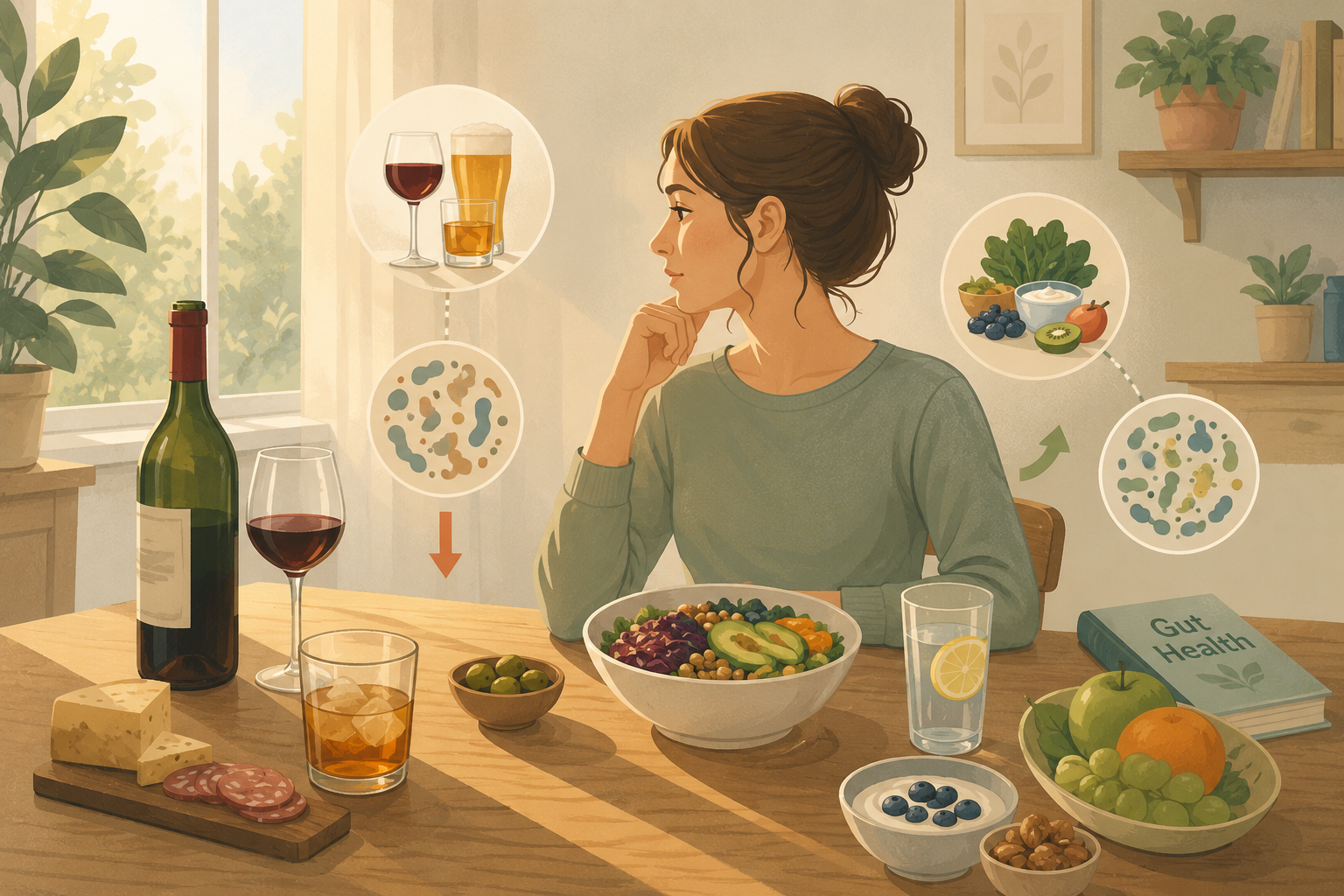
Most people know that alcohol is hard on the liver. Fewer people know that the damage begins somewhere else entirely, in the hundreds of trillions of bacteria living in your gut.
Over the last decade, research into the gut microbiome has changed how scientists understand what alcohol actually does to the body. Alcohol does not simply irritate your digestive system on a bad morning. It reshapes the bacterial ecosystem that helps regulate immunity, mood, metabolism, and your relationship with alcohol itself.
That is not a niche biochemistry concern. The changes alcohol makes to your gut bacteria can affect almost every organ in your body. They may also help explain why cutting down often feels harder than it should. The good news is that the gut microbiome is remarkably good at recovering once you give it a chance.
What the gut microbiome actually is
Your gut microbiome is the name for the trillions of microorganisms, mostly bacteria, that live in your digestive tract. The greatest concentration sits in your large intestine.
These bacteria are not just passengers. They break down fibre into energy, produce vitamins your body cannot make on its own, train your immune system to distinguish a real threat from a harmless one, manufacture neurotransmitters that influence how your brain feels, and help maintain the integrity of the gut wall that separates the contents of your intestine from your bloodstream.
When this community is diverse and balanced, scientists call it eubiosis. When it is disrupted and imbalanced, they call it dysbiosis. Alcohol is one of the most powerful disruptors known.
How alcohol gets to your gut bacteria in the first place
It helps to understand how alcohol actually reaches your gut, because that explains why the effects can be so far reaching.
Alcohol does not go through normal digestion in the same way as most food and drink. A significant proportion is absorbed directly through the stomach and small intestine into the bloodstream. But some still reaches the large intestine intact, where it comes into direct contact with your microbial community.
The bacteria living there can metabolise ethanol. When they do, they produce a toxic byproduct called acetaldehyde. This compound contributes to flushing, nausea, and racing heart while drinking or the morning after. In the gut, it damages the cells lining the intestinal wall and can alter bacterial balance even after a single episode of heavier drinking.
The specific ways alcohol reshapes your bacterial community
- Beneficial bacteria decline. Species such as Faecalibacterium prausnitzii and Bifidobacterium, which help regulate inflammation and immune function, fall. Lactobacillus populations, which help maintain the protective mucus layer lining the gut wall, also drop.
- Harmful bacteria increase. As beneficial species decline, Proteobacteria can expand. These bacteria carry lipopolysaccharide, or LPS, in their outer membrane. LPS is toxic to human tissue in large quantities, and higher Proteobacteria levels mean more LPS production in the gut.
- Overall diversity collapses. A healthy gut microbiome depends on diversity, many different species doing many different jobs. Alcohol related dysbiosis reduces that diversity and leaves the ecosystem less resilient and less adaptable.
These changes do not require someone to be drinking at dangerous levels to take hold. The effects are dose dependent. More drinking, and more frequent drinking, usually means more disruption. But the direction of travel is the same.
Leaky gut: what it is and why it matters for every organ in your body
One of the most clinically significant consequences of alcohol related dysbiosis is something researchers call intestinal hyperpermeability. Most people know it as leaky gut.
The gut wall is not just a tube. It is a single-cell-thick barrier, sealed together by tight junction proteins that control what crosses from the intestinal contents into the bloodstream. In a healthy gut, nutrients pass through and everything else is kept out.
Alcohol disrupts those tight junction proteins directly. Combined with the decline in Lactobacillus, which helps support the mucus layer protecting those junctions, the barrier becomes more permeable. Gaps open. Things that should stay in the gut begin crossing into the bloodstream.
What crosses those gaps is the problem. LPS, produced in increasing quantities by the Proteobacteria that alcohol encourages, leaks into the bloodstream and triggers the immune system to mount an inflammatory response.
The liver, which receives blood directly from the gut via the portal vein, is first in line. That helps explain why alcohol related liver disease often co-occurs with gut damage. But the inflammatory signal does not stop there. It travels through the circulation to the lungs, the heart, and the brain.
Brain fog, memory difficulties, and anxiety that feels out of proportion to circumstances are not separate from the gut. They may be downstream of it.
How your gut bacteria influence your mood and your sleep
Most of the body’s serotonin is produced in the gut, not the brain. GABA, the neurotransmitter tied to calm and inhibition, is also partially regulated by gut microbes. Bifidobacterium and Lactobacillus species are known to support GABA precursors and the short chain fatty acids that help brain signalling stay healthy.
When alcohol depletes these populations, the downstream effects are neurological as well as digestive. Anxiety can increase. Sleep can get worse. Mood regulation can become more effortful.
That creates a pattern many people recognise without understanding the mechanism. Drinking disrupts sleep and increases anxiety, so sleep gets worse and anxiety increases, so drinking feels more necessary, so sleep and anxiety worsen further.
A 2024 study found that valerate, a short chain fatty acid produced by healthy gut bacteria, reduced voluntary alcohol intake in animal models, likely by modulating dopamine reward pathways involved in compulsive drinking. Early clinical studies have also found that people with alcohol use disorder who had more severe gut dysbiosis experienced more intense cravings and higher depression scores.
What happens to short chain fatty acids
Short chain fatty acids, mainly butyrate, propionate, and acetate, are produced when gut bacteria ferment dietary fibre. They do a remarkable range of jobs.
Butyrate deserves special attention. It is the primary fuel source for the cells lining your colon. It helps seal the tight junctions that prevent leaky gut. It reduces gut inflammation. It modulates immune responses throughout the body. Research in recent years has also linked it to support for the blood brain barrier, the protective layer that controls what enters the brain from the circulation.
Alcohol reduces short chain fatty acid production substantially. Laboratory work using simulated human gut models has found that alcohol can significantly cut butyrate, propionate, and acetate production, with measurable consequences for gut integrity and systemic inflammation.
The bacteria most affected, including Faecalibacterium prausnitzii, are among the species most consistently depleted in people who drink heavily. The less butyrate your gut produces, the more vulnerable the gut wall becomes and the more LPS crosses into the bloodstream.
What about the brain specifically
The gut brain axis is the two way communication network between the gut and the central nervous system. It runs via the vagus nerve, the immune system, the endocrine system, and the signalling molecules, including neurotransmitters produced by gut bacteria, that pass between the two systems constantly.
Significant alterations in the gut microbiome can occur in alcohol use disorder before many other systemic signs or symptoms become clinically obvious. Reviews of the evidence point to a self reinforcing triangle: gut dysbiosis, systemic inflammation, and neuroinflammation.
Inflammation in the gut drives inflammation in the brain. Neuroinflammation disrupts decision making, impulse control, and emotional regulation. Disrupted emotional regulation makes alcohol feel more necessary. And the cycle continues.
Researchers have even begun using the gut microbiome as a diagnostic tool. A machine learning model trained on the profiles of just 20 faecal microbiome strains was able to classify patients with alcohol related liver disease and cognitive impairment with 84% specificity.
The recovery picture, and it is genuinely encouraging
Here is the hopeful part, and it is worth saying plainly. The gut microbiome is not permanently damaged by alcohol. It is plastic, responsive, and capable of meaningful recovery when the disruption stops.
Within one week of stopping drinking, studies show that biomarkers of intestinal permeability begin to improve. Tight junctions start to reseal. LPS levels in the bloodstream fall. Intestinal fatty acid binding protein, a marker of gut wall damage, improved after just seven days of abstinence in patients with alcohol related liver disease.
Over weeks and months, microbial balance shifts back towards greater diversity and a higher proportion of beneficial species. Research in Gut Microbes found that abstinence functions as a direct positive microbiome intervention, with measurable improvements in both bacterial diversity and composition across people with varying histories of alcohol use.
Recovery varies depending on how long someone has been drinking heavily, their diet, their age, and other individual factors. But the direction is consistent across the evidence: stop the disruption and the gut responds.
Probiotics appear to accelerate that recovery. Clinical trials using Lactobacillus rhamnosus and Lactobacillus helveticus found that short supplementation periods reduced LPS levels, improved liver function markers, and shifted the bacterial balance towards beneficial species in people with alcohol related liver disease. Other trials have found similar results with Bifidobacterium strains.
Practical steps that are backed by evidence
You do not need to be in formal treatment for any of this to matter. Whether you are taking some alcohol free days, cutting down your weekly units, or stopping altogether, these steps are backed by research.
- Eat more fibre. Vegetables, legumes, oats, and wholegrains feed butyrate producing bacteria. This is one of the most evidence supported things you can do for gut health.
- Add fermented foods. Live culture yoghurt, kefir, sauerkraut, kimchi, and kombucha introduce beneficial bacteria directly. Regular fermented food consumption is linked with higher microbiome diversity and lower inflammatory markers.
- Consider a good probiotic. The strains with the strongest clinical evidence in the context of alcohol use include Lactobacillus rhamnosus, Lactobacillus helveticus, and Bifidobacterium species. Look for products that name specific strains rather than generic labels.
- Cut back on ultra processed food. High sugar, high fat diets compound the dysbiosis that alcohol creates. Diets high in processed food independently reduce microbial diversity.
- Be patient but realistic about the timeline. The gut lining renews itself roughly every three to five days. Significant microbiome improvements become measurable within weeks of sustained behaviour change.
A note about SafeStep
SafeStep is a personalised digital alcohol treatment programme, developed with NHS clinical partners and designed around the individual. It adapts to your pattern of drinking, your life, and your goals, rather than offering a generic programme that assumes everyone starts from the same place.
If you are thinking about your drinking and want support that actually fits you, this is the work SafeStep is building towards.


Join the waitlist.
Get the first invite when SafeStep launches, plus the occasional progress update while we finish building.
We’ll only email you when SafeStep is ready to try, plus the occasional product update while we build.
Status message
Frequently asked questions
Can moderate drinking affect gut bacteria, or is this only a problem for heavy drinkers?
How long does the gut microbiome take to recover after stopping drinking?
Is there a connection between gut bacteria and alcohol cravings?
Do probiotics actually help during alcohol recovery?
Does alcohol permanently damage the gut?
What foods are best for restoring gut bacteria?
Research references: Merlo Pich et al., Neurobiology of Stress (2025); Alexandrescu et al., Microorganisms (2025); McMahan et al., Frontiers in Immunology (2024); Valerate and alcohol seeking behaviour study (2024); Tierney et al., Applied and Environmental Microbiology (2023); Lowe et al., Gut Microbes (2020); Chen et al., Frontiers in Microbiology (2022); Bajaj et al. clinical machine learning study (2024). All studies were peer reviewed and are publicly indexed via PubMed or PMC.
Share this article
Related reading

Do I have a drinking problem? The question most people are afraid to answer honestly
Most people who ask this question are not in crisis. They are in the grey area. This is the honest, research-backed guide to understanding your relationship with alcohol without the scaremongering.

Early alcohol recovery: what nobody actually tells you
Nobody tells you about the 9pm on a Tuesday feeling. This is the honest, UK-specific guide to what early alcohol recovery actually feels like - and why the hard parts are signs you're doing it right.