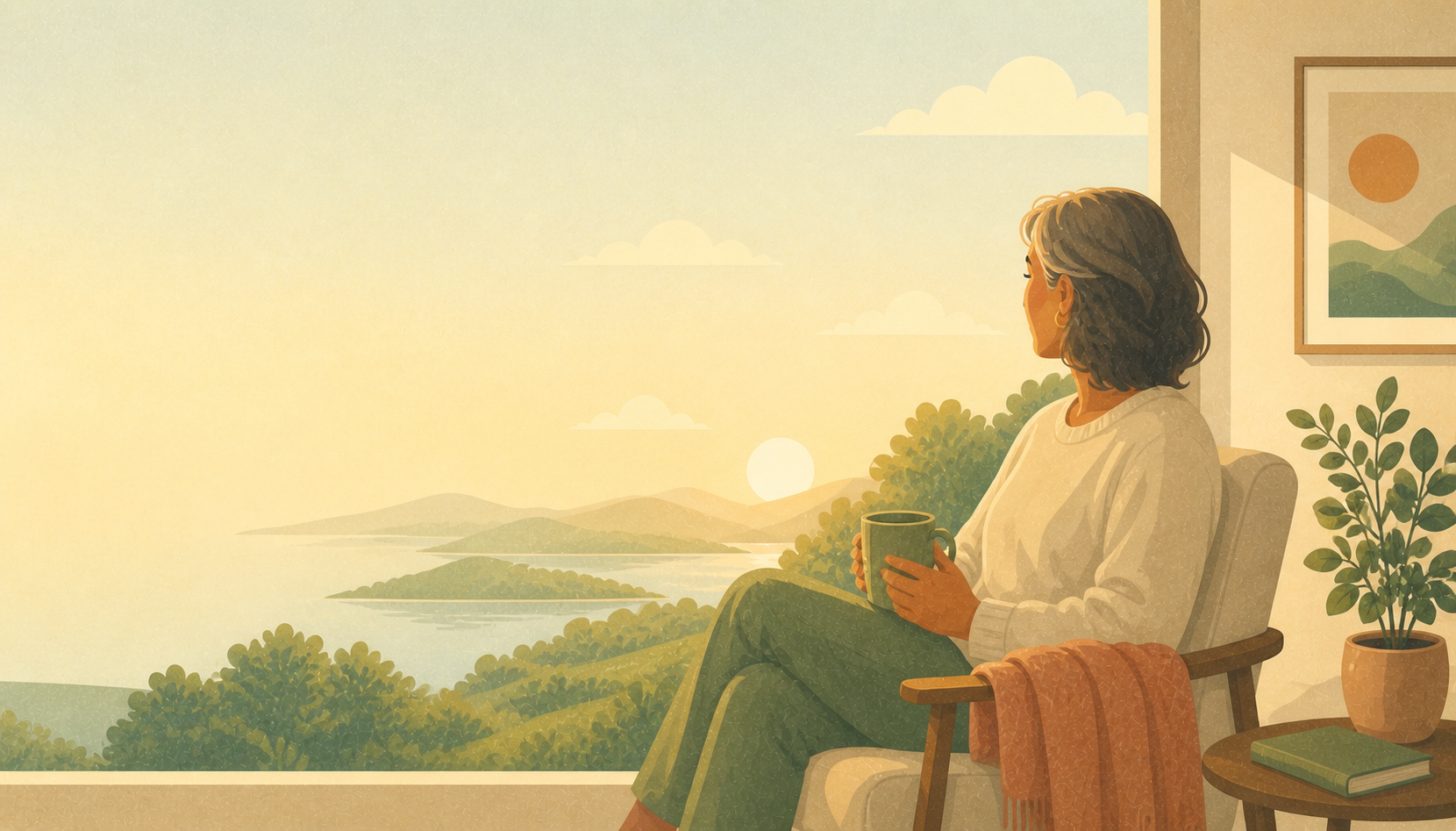
It happens quietly, usually. A glass of wine with dinner becomes two. The bottle that used to be opened on a Friday gets opened on a Thursday. The drink appears a little earlier, a little more automatically, and somehow more necessary than it did a year ago.
You are not imagining it. And it is probably not what you think it is.
A 2024 survey published in BJPsych Open found that one in three women reported drinking more during the perimenopause or menopause. Of those women, 70% said anxiety, stress, or depression was the reason. A quarter said they were spending up to £50 a week on alcohol. The important part is not only that the pattern changes. It is that many women do not connect what is happening in the glass to what is happening in the body.
The age range nobody talks about
When people talk about menopause, they often picture a specific moment: a woman in her early fifties, hot flushes, periods ending, and then a clear after. In reality, the transition is broader, messier, and often starts much earlier.
The NHS says menopause usually affects women between the ages of 45 and 55, but symptoms can start years before periods stop. That earlier phase is called perimenopause. It can begin in the early forties, and sometimes even in the late thirties. Early menopause is defined as occurring before 45, and premature menopause before 40.
That matters because the window in which hormones affect mood, sleep, and anxiety can last for years, not months. For a large part of that time, many women do not know they are in perimenopause at all.
- Perimenopause often starts years before the final period
- Mood changes, sleep disruption, anxiety, and brain fog can appear before periods become irregular
- Early menopause and premature menopause are recognised clinical categories, not edge cases
- The transition can overlap with work pressure, caregiving, and other midlife stressors
What is actually happening in the body
Oestrogen is not just about reproduction. It has effects throughout the brain and body, including on systems involved in mood, anxiety, sleep, and temperature regulation.
During perimenopause, oestrogen does not simply drift downward in a straight line. It fluctuates. That instability can leave mood less steady, anxiety more intense, and sleep more fragile. Many women describe waking at 3am, struggling to get back to sleep, or feeling mentally foggy and unlike themselves.
The NHS lists anxiety, low mood, brain fog, difficulty sleeping, hot flushes, and night sweats as common menopause and perimenopause symptoms. None of that is imaginary. It is physiology.
Alcohol arrives into that landscape with what feels like relief. In the short term, it can blunt anxiety and make falling asleep feel easier. That does not mean the body is being helped. It means the body has found a fast, familiar way to temporarily quiet the signal.
Why alcohol feels helpful, and why that becomes a problem
Alcohol enhances GABA activity, which is one reason it can feel calming in the moment. If oestrogen shifts are already making a woman more anxious, more wired, or less able to sleep, that short-term effect can look like a solution.
The problem is that alcohol usually makes the underlying issue worse over time.
It helps you fall asleep, but it fragments sleep later in the night. It reduces anxiety briefly, then creates a rebound effect as it wears off. It can deepen low mood. And because it acts as a vasodilator, it can make hot flushes and night sweats feel more intense for some women.
That is how a drink becomes a pattern. It starts as relief, then becomes the thing the body seems to want every time the body is struggling. The mechanism is not weakness. It is the nervous system reaching for the fastest available brake.
Why it becomes a problem
The relief is real. So is the cost.
Sleep gets more fragile rather than less. Anxiety rebounds into the next day. The body gets less restorative rest while the mind learns to expect alcohol as the answer to discomfort.
The longer-term health picture matters too. Alcohol Change UK and Cancer Research UK both note that alcohol increases the risk of breast cancer, and the risk rises with intake. That risk sits on top of the risk profile already changing during midlife as oestrogen levels fall.
In other words, the drink that helps tonight is working against the body that has to carry you through the next decade and beyond.
The women who fall between the systems
There is a structural problem here. Menopause care and alcohol treatment often sit in different parts of the health system, and they do not routinely talk to each other.
Menopause services do not always ask about alcohol. Alcohol services do not always ask about hormonal stage, changing sleep, or whether a woman’s drinking increase started with perimenopause. That leaves women being treated for one part of the problem while the rest stays hidden.
The result is a woman who has been told her blood tests are normal, who may have tried antidepressants that do not fully address the problem, and who still has not been asked whether her drinking changed at the same time as her hormones.
Tailored care matters here because the driver is often not just alcohol. It is alcohol plus sleep disruption, plus anxiety, plus a life stage that is easy to overlook.
Postmenopause: the pattern that can stay
The menopausal transition does not last forever, but the drinking pattern that develops during it can outlast the symptoms that started it.
For some women, once sleep and anxiety settle, drinking naturally drops too. For others, the habit has become detached from the original trigger. The glass that once seemed to fix 3am waking becomes the glass that is simply there.
That is why postmenopause is not automatically the end of the story. It may be the point at which a pattern either loosens or hardens. Without support, it can drift into something quieter but more established.
What actually helps
Get the hormonal picture right. If you are in your late thirties, forties, or fifties and your sleep, anxiety, or mood have changed in ways that do not make sense, ask your GP specifically about perimenopause. You do not need to wait for your periods to stop before it is worth asking.
Be honest about alcohol. If you are seeing a menopause clinician, say how much you are drinking. If you are already in alcohol treatment, tell them where you are in the menopausal transition. Those conversations are often missing, and they matter.
Track the pattern. For two weeks, notice when you drink, how much, what time of day it happens, and how you feel the next morning. Many people find the connection between the evening drink and the following day’s anxiety, sleep, or mood is stronger than they expected.
Choose support that addresses the same problems alcohol is trying to solve. That may include menopause treatment, cognitive behavioural therapy, sleep support, movement, and practical routines around the times of day when anxiety hits hardest.
- Ask a GP or menopause specialist about perimenopause directly
- Tell alcohol services that your drinking changed during midlife hormone change
- Track drinking against sleep, mood, and anxiety for at least two weeks
- Look for support that treats the cause of the coping, not just the coping itself
What SafeStep is building
SafeStep is a personalised digital alcohol treatment programme being developed with NHS partners, addiction specialists, and people with lived experience.
The goal is to adapt to the person, not force every person through the same static plan. If a midlife woman’s drinking is being driven by sleep disruption, anxiety, or hormonal change, that context should shape the support she sees.
We are currently field testing with NHS alcohol services in Devon and Cornwall. SafeStep is being designed to combine personalised check-ins, guided sessions, medication support, recovery tools, meeting recommendations, and practical next steps in one place.


Join the waitlist.
Get the first invite when SafeStep launches, plus the occasional progress update while we finish building.
We’ll only email you when SafeStep is ready to try, plus the occasional product update while we build.
Status message
Useful UK resources
If you want somewhere to start, these UK resources are useful and low-friction. You do not need to use all of them. One honest conversation is enough for today.
- NHS menopause information: nhs.uk/conditions/menopause
- Drinkline (free, confidential): 0300 123 1110
- Alcohol Change UK: alcoholchange.org.uk
- SMART Recovery UK: smartrecovery.org.uk
- Newson Health: newsonhealth.co.uk
Frequently asked questions
Can perimenopause make you drink more?
Does alcohol make menopause symptoms worse?
What age can perimenopause start?
What should I do if I think menopause is affecting my drinking?
Share this article
Related reading

Early alcohol recovery: what nobody actually tells you
Nobody tells you about the 9pm on a Tuesday feeling. This is the honest, UK-specific guide to what early alcohol recovery actually feels like - and why the hard parts are signs you're doing it right.

How to support someone in alcohol recovery: what actually helps (and what doesn’t)
A practical, research-informed guide for partners, family, and friends supporting someone in alcohol recovery, including what helps, what does not, and how to stay useful between appointments.